Canada Study Permit Changes 2026: New Proof of Funds, Cap and PAL Rules
· Site Administrator
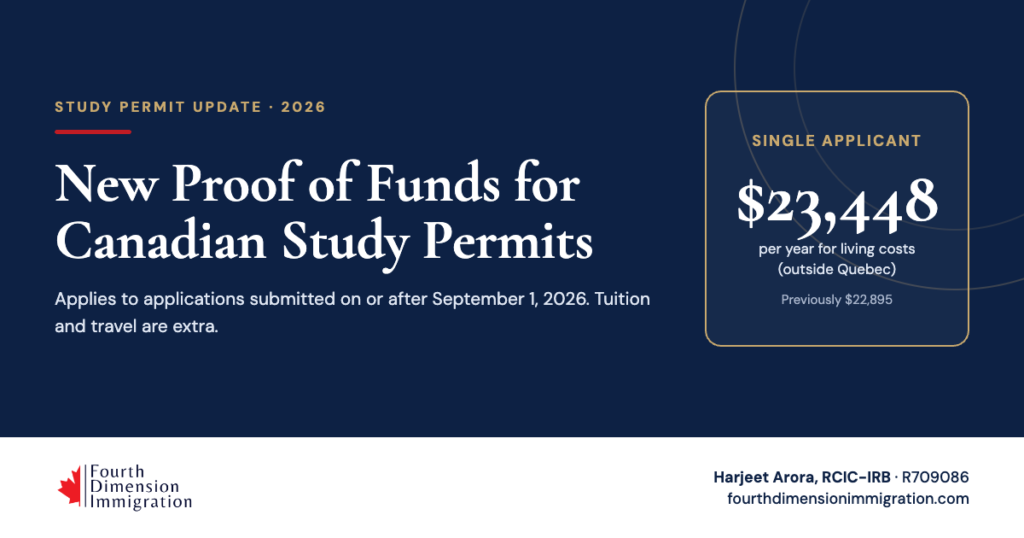
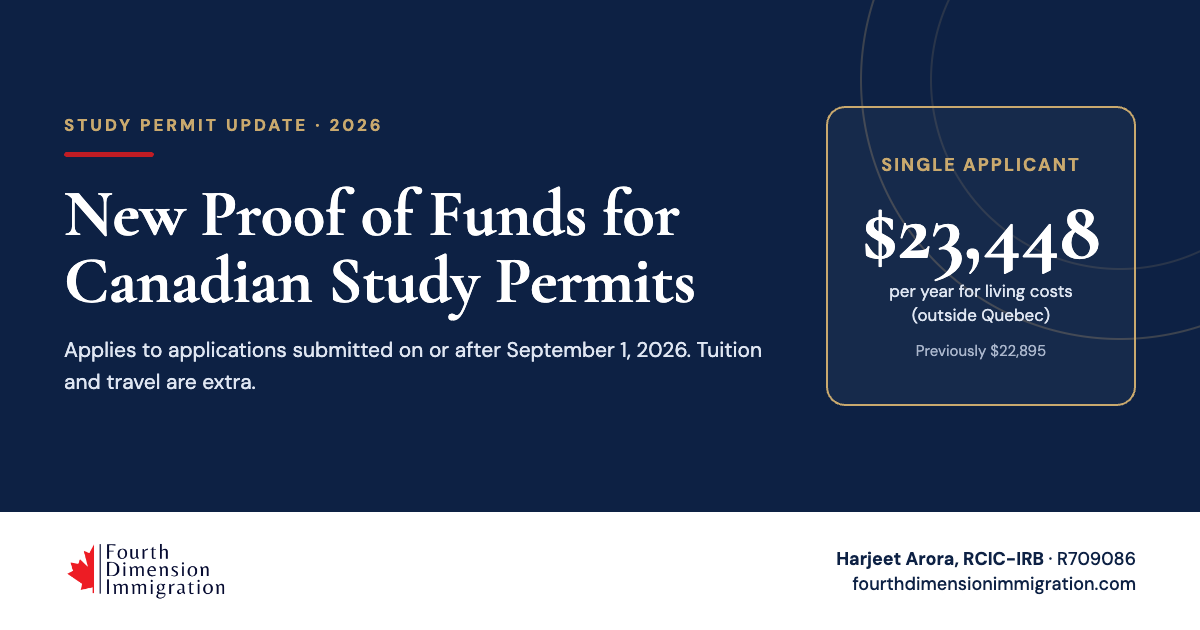
The study permit proof of funds requirement increased on September 1, 2026. If you apply on or after that date, IRCC expects you to show at least $23,448 for one year of living expenses (single applicant, outside Quebec), plus your first-year tuition and travel costs. In addition, 2026 brought a lower national cap, new exemptions from the provincial attestation letter (PAL/TAL), and new work rules for co-op students.
Key Takeaways
- Study permit proof of funds increased: $23,448 for a single applicant (up from $22,895) for applications submitted on or after September 1, 2026.
- Smaller cap: IRCC plans to issue 408,000 study permits in 2026 and will accept up to 309,670 cap-subject applications into processing.
- Master’s and PhD students at public institutions no longer need a PAL/TAL and are outside the cap (from January 1, 2026).
- Co-op students no longer need a separate co-op work permit (from April 1, 2026).
- Off-campus work remains capped at 24 hours per week during academic sessions.
1. New Study Permit Proof of Funds Amounts for 2026
Every study permit applicant must show they can pay for their first year of tuition, return transportation, and living expenses in Canada. Also, IRCC updates the study permit proof of funds amount each year. The amounts below apply to applications submitted on or after September 1, 2026, for study anywhere in Canada except Quebec.
| Number of family members (including the applicant) | Minimum funds required per year (CAD) |
|---|---|
| 1 | $23,448 |
| 2 | $29,192 |
| 3 | $35,888 |
| 4 | $43,572 |
| 5 | $49,419 |
| 6 | $55,736 |
| 7 | $62,054 |
| Each additional family member | $6,318 |
Source: IRCC, “Study permit: Get the right documents, Proof of financial support,” page modified August 28, 2026.
These amounts do not include tuition or travel. For example, a single applicant whose first-year tuition is $20,000 must show at least $43,448 plus the cost of travel to Canada.
Studying in Quebec? Quebec sets its own financial requirements for the Quebec Acceptance Certificate (CAQ). Check the current amount with the Ministère de l’Immigration, de la Francisation et de l’Intégration (MIFI) before applying.
How to show study permit proof of funds
IRCC accepts several types of evidence. For example:
- A Guaranteed Investment Certificate (GIC) from a participating Canadian financial institution
- Recent bank statements in your name or your sponsor’s name
- Proof of an education or student loan from a financial institution
- Proof of a scholarship or funding from your school, government, or another organization
- Proof that you have already paid tuition and housing fees
However, documentation requirements can differ, so check the IRCC instructions for your country and application type.
Practitioner insight: In refusals we review, the issue is often not the balance itself but its source. Large, recent, unexplained deposits, funds held by a sponsor with no clear link to the applicant, or income that does not match the sponsor’s documented employment can lead an officer to doubt the funds are really available. Therefore, a short explanation letter with a clear paper trail (property sale, savings history, salary records) usually helps more than a higher balance.
2. The 2026 International Student Cap
In November 2025, IRCC confirmed that it expects to issue 408,000 study permits in 2026: about 155,000 for newly arriving students and 253,000 extensions for students already in Canada. In other words, that is roughly 7% lower than the 2025 target of 437,000.
Ministerial Instructions published in the Canada Gazette on December 20, 2025 set a maximum of 309,670 cap-subject study permit applications that IRCC will accept into processing between January 1 and December 31, 2026. IRCC divides this number among provinces and territories. Ontario receives the largest allocation of study permits (70,074).
Therefore, if your application is subject to the cap and does not include a valid provincial or territorial attestation letter (PAL/TAL), IRCC will return it as incomplete and refund the fee.
3. Who No Longer Needs a PAL or TAL
Starting January 1, 2026, the following applicants are exempt from the PAL/TAL requirement:
- Master’s and doctoral students at public designated learning institutions (DLIs). This is the main new exemption for 2026.
- Primary and secondary school students (kindergarten to grade 12)
- Exchange students and certain government-funded scholarship recipients
- Certain priority and vulnerable groups identified by the Government of Canada
- Study permit holders extending their permit at the same school and level of study
In February 2026, IRCC also updated its instructions so that students in joint programs need only one PAL/TAL, even when the program involves more than one institution or province. IRCC now treats master’s and doctoral programs as the same level of study for PAL/TAL purposes.
On the other hand, college diploma, undergraduate, and most non-degree programs still require a PAL/TAL. If you are in one of these programs, confirm your school has issued the letter before you apply.
Refused a study permit, or not sure your funds will be accepted?
We review study permit refusals, GCMS notes, and financial evidence before you reapply.
4. Work Rules for International Students in 2026
No separate co-op work permit
As of April 1, 2026, eligible post-secondary students no longer need a separate co-op work permit for a work placement (such as a co-op, internship, or practicum) that is required by their program. However, the student’s DLI must approve the employer.
Off-campus work stays at 24 hours per week
Meanwhile, eligible students can work up to 24 hours per week off campus during academic sessions and unlimited hours during scheduled breaks such as summer and winter holidays. However, students who are not studying full time, or who are on an authorized leave, generally cannot work off campus.
5. Compliance Rules Students Should Know
IRCC updated its compliance guidance in June 2026. Key points for current students:
- Changing schools: First, you must apply for a new study permit before transferring to a different DLI. You can change programs at the same school without a new permit.
- Completing studies: IRCC considers your studies complete on the date your school first notifies you (by completion letter, transcript, or credential). Your study permit becomes invalid 90 days after that date.
- Leave from studies: IRCC limits authorized leave to 150 days, and you cannot work off campus during a leave.
- Post-Graduation Work Permit (PGWP): Finally, graduates of non-credit programs (other than flight school programs) are not eligible for a PGWP.
6. Work Permit Holders Can Study Short Programs Without a Study Permit
A new temporary public policy took effect on September 4, 2026 and runs until December 31, 2027. It allows people who hold a valid work permit to take a course or program of six months or less without a study permit, even if the program ends after the period of stay they were authorized when they first entered Canada. This replaces an earlier policy that expired on June 27, 2026.
For programs longer than six months, you still need a study permit. In addition, all other eligibility and admissibility requirements continue to apply.
What the New Study Permit Proof of Funds Rules Mean for You
- Applying now: Plan your study permit proof of funds around the new $23,448 figure (or the higher family amount) plus full first-year tuition and travel. An application based on the old $22,895 amount may fall short.
- Graduate students: If you are admitted to a master’s or PhD program at a public DLI, you do not need a PAL/TAL, but you must still meet every other requirement, including proof of funds and genuine intent as a temporary resident.
- College and undergraduate students: Secure your PAL/TAL early. Because allocations are limited, schools may run out.
- Current students: Before changing schools, reducing your course load, or taking a leave, check how it affects your study permit conditions, work eligibility, and future PGWP.
- Previously refused? Read the refusal reasons carefully and consider requesting your GCMS notes before reapplying. Submitting the same application again rarely changes the result.
Frequently Asked Questions
What is the study permit proof of funds amount in 2026?
For study permit applications submitted on or after September 1, 2026, proof of funds for a single applicant studying outside Quebec must be at least $23,448 for living expenses, plus first-year tuition and travel costs.
I applied before September 1, 2026. Does the new study permit proof of funds amount apply?
IRCC applies the new amounts to applications submitted on or after September 1, 2026. However, IRCC assessed applications submitted earlier under the previous amount of $22,895 for a single applicant.
Is a GIC mandatory for study permit proof of funds?
A GIC is one accepted way to prove funds. Whether you need one depends on how you apply. For most applicants, IRCC may also accept other evidence such as bank statements, loans, or scholarships.
Do master’s students need a PAL in 2026?
No. From January 1, 2026, master’s and doctoral students at public DLIs are exempt from the PAL/TAL requirement and do not count toward the cap.
How many hours can international students work off campus?
You can work up to 24 hours per week during academic sessions and unlimited hours during scheduled breaks, if you meet the eligibility conditions on your study permit.
Official Sources
- IRCC: Proof of financial support for a study permit
- IRCC: 2026 provincial and territorial allocations under the international student cap
- Canada Gazette, Part I (December 20, 2025): Ministerial Instructions on study permit applications
- IRCC: Provincial or territorial attestation letter
- IRCC: Simplifying the co-op work permit requirement
- IRCC: Work off campus as an international student
- IRCC: Temporary public policy for work permit holders to study without a study permit (expires December 2027)
Related Pages
- Study Permit Applications
- Study Permit Refusal
- Working While Studying
- Post-Graduation Work Permit
- DLI and Letter of Acceptance
About the Author
Harjeet Arora, RCIC-IRB (CICC Registration No. R709086) is the founder of Fourth Dimension Immigration Inc. in Mississauga, Ontario. He represents clients before IRCC, CBSA, and the Immigration and Refugee Board of Canada.
Unit 250, 7025 Tomken Road, Mississauga, ON L5T 2J8 | +1 647 909 7777 | [email protected]
This page provides general information only and is not legal advice. Immigration law and IRCC and CBSA policies change often, and every case depends on its own facts. For advice on your situation, book a consultation with Harjeet Arora, RCIC-IRB (R709086). Submitting an application or retaining FDI does not guarantee any outcome.